
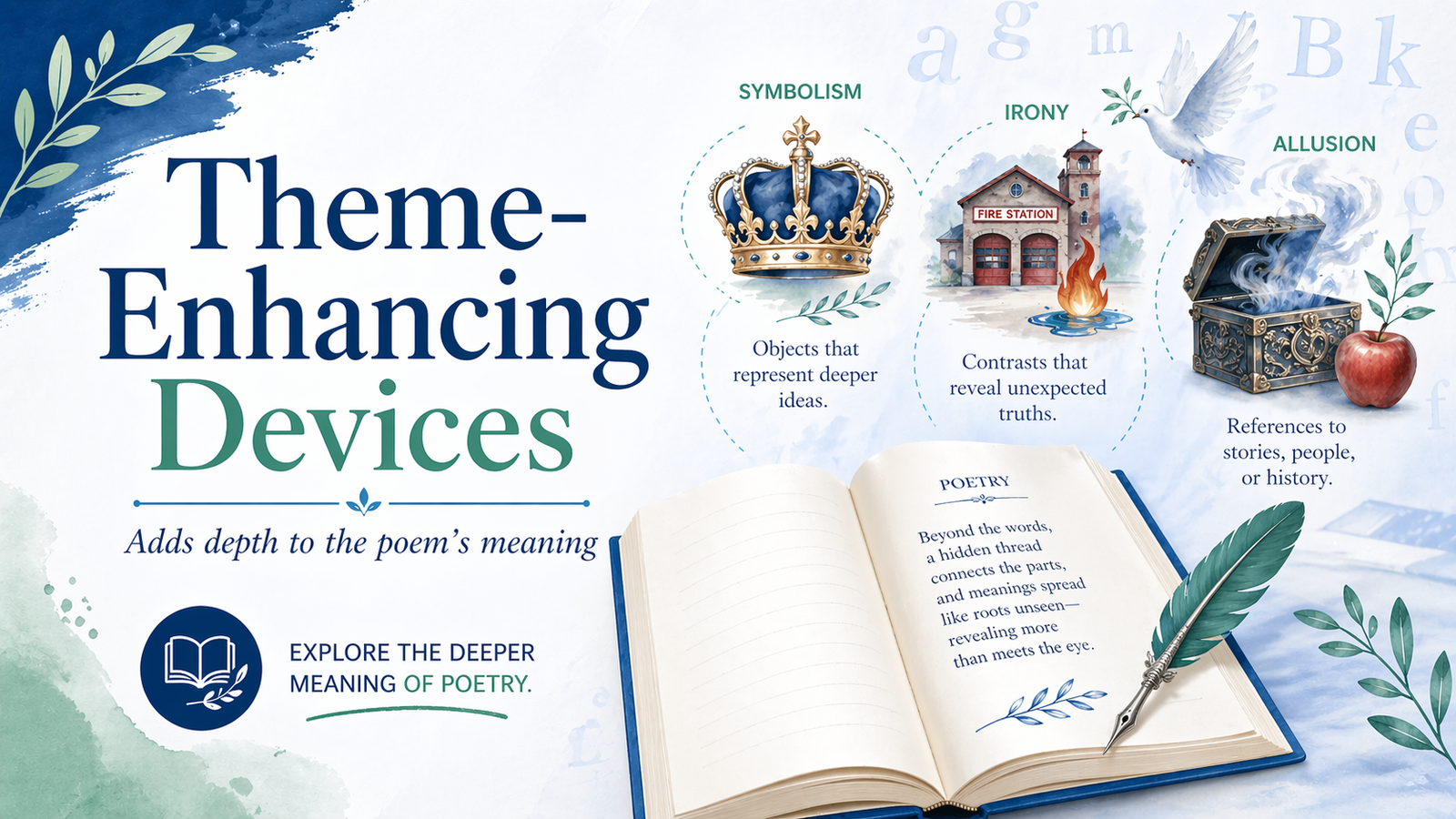
Theme-enhancing devices help deepen the meaning of a poem. They allow poets and writers to connect simple images, situations, or references to larger ideas and themes.
1. Symbolism
Definition: Using symbols to represent larger ideas.
Examples:
i.
“The crown lay heavy on the king’s head, a constant reminder of his responsibilities.”
The crown symbolizes power and the burdens of leadership.
ii.
“The dove flew above the battlefield, a sign that peace would soon prevail.”
The dove symbolizes peace.
2. Irony
Definition: Irony highlights contradictions, often to create humour, tension, or emphasize truths.
Examples:
i.
“A fire station burns down”.
It is an Irony because a place meant to prevent fires gets destroyed by fire itself.
ii.
“The plumber’s house was flooded because of a broken pipe.”
Irony because the plumber, who fixes others’ pipes, failed to fix their own.
3. Allusion
Definition: Referring to a well-known person, event, or work of art. Allusions draw from history, mythology, literature, or culture, enriching the text by connecting it to external references.
Examples:
i.
“She opened the box, knowing full well it might lead to chaos—a real Pandora’s box.”
Allusion to the Greek myth of Pandora, whose box unleashed trouble into the world.
ii.
“The apple in the garden was theirs for the taking…” (Paradise Lost, John Milton)
Alludes to the Biblical story of Adam and Eve, symbolizing temptation and the fall of mankind.