
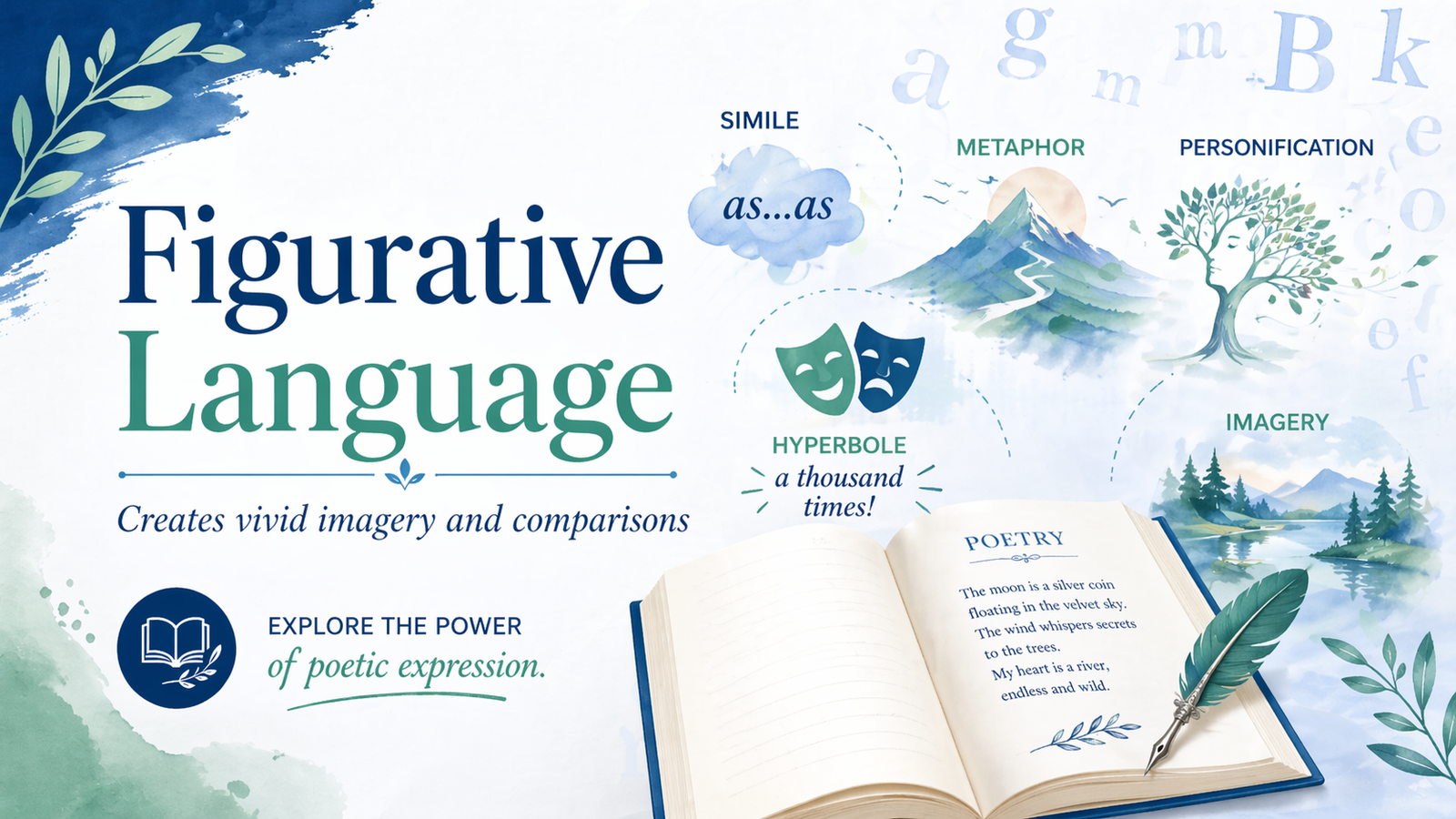
1. Simile
Definition: Comparing two things using “like” or “as”, creating vivid imagery.
Examples:
i. “Life is like a box of chocolates…” (from Forrest Gump)
Just like you can’t see what’s inside a box of chocolates until you open it, you don’t know what experiences, challenges, or opportunities life will bring.
ii. “I wandered lonely as a cloud…” (William Wordsworth)
The poet compares his loneliness to a solitary cloud drifting in the sky.
2. Metaphor
Definition: Metaphors are comparisons that don’t use “like” or “as,” allowing poets and writers to express ideas vividly and creatively.
Examples:
i. One of the most famous examples of metaphor is Shakespeare’s
“All the world’s a stage, and all the men and women merely players.” (As You Like It)
Life is metaphorically compared to a stage, suggesting that people perform different roles in life and have entrances and exits i.e., life and death, much like actors in a theatrical production.
ii. “Shall I compare thee to a summer’s day?”
As we’ve read it before, the poet metaphorically likens his loved one’s beauty to a perfect summer day, symbolizing warmth and loveliness.
[thee = you]
Difference between Simile and Metaphor
| Aspect | Simile | Metaphor |
|---|---|---|
| Definition | A comparison between two things using “like” or “as.” | A direct comparison between two things without using “like” or “as.” |
| Purpose | Highlights similarities between two objects explicitly. | Implies a similarity, creating a deeper or more symbolic connection. |
| Example | “Time is like an old gypsy man.” | “Time is an old gypsy man.” |
| Usage | Easier for readers to identify the comparison. | Often more subtle and open to interpretation. |
| Impact | Creates vivid imagery with a straightforward comparison. | Adds layers of meaning and encourages deeper thinking about the relationship. |
3. Personification
Definition: Giving human qualities to non-human things.
Example: “The wind whispered through the trees”.
Examples:
i.
“Because I could not stop for Death—
He kindly stopped for me—” (Emily Dickinson)
This is a brilliant example of personification where death is personified as a polite and considerate figure, almost like a companion. The poet, just as a normal human being, was not ready to die. Therefore, as if death, as a person, stopped for her.
ii.
“The night was creeping towards them on long black legs.” (The Hobbit, J.R.R. Tolkien)
Night is personified as a creature with legs, actively advancing.
4. Hyperbole
Definition: Exaggeration for effect.
Example: “I’ve told you a million times!”
Example:
“A hundred years should go to praise
Thine eyes, and on thy forehead gaze.”
(To His Coy Mistress, Andrew Marvell)
Hyperbole to emphasize the poet’s admiration and desire for his beloved.
(Thine/thy = your)
5. Imagery
Definition: Using descriptive language to appeal to the senses.
Example: “The crisp autumn leaves crunched underfoot”.
Example:
“The woods are lovely, dark and deep,
But I have promises to keep…”
(Stopping by Woods on a Snowy Evening, Robert Frost)
Frost’s description of the dark woods evokes a quiet, mysterious atmosphere, appealing to sight and mood.