
Poetic devices are tools or techniques that poets use to enhance the beauty, meaning, or sound of their poetry. They add layers of depth and imagery to the language, making the poetry more evocative and engaging.
We can divide the poetic devices into different categories, such as:
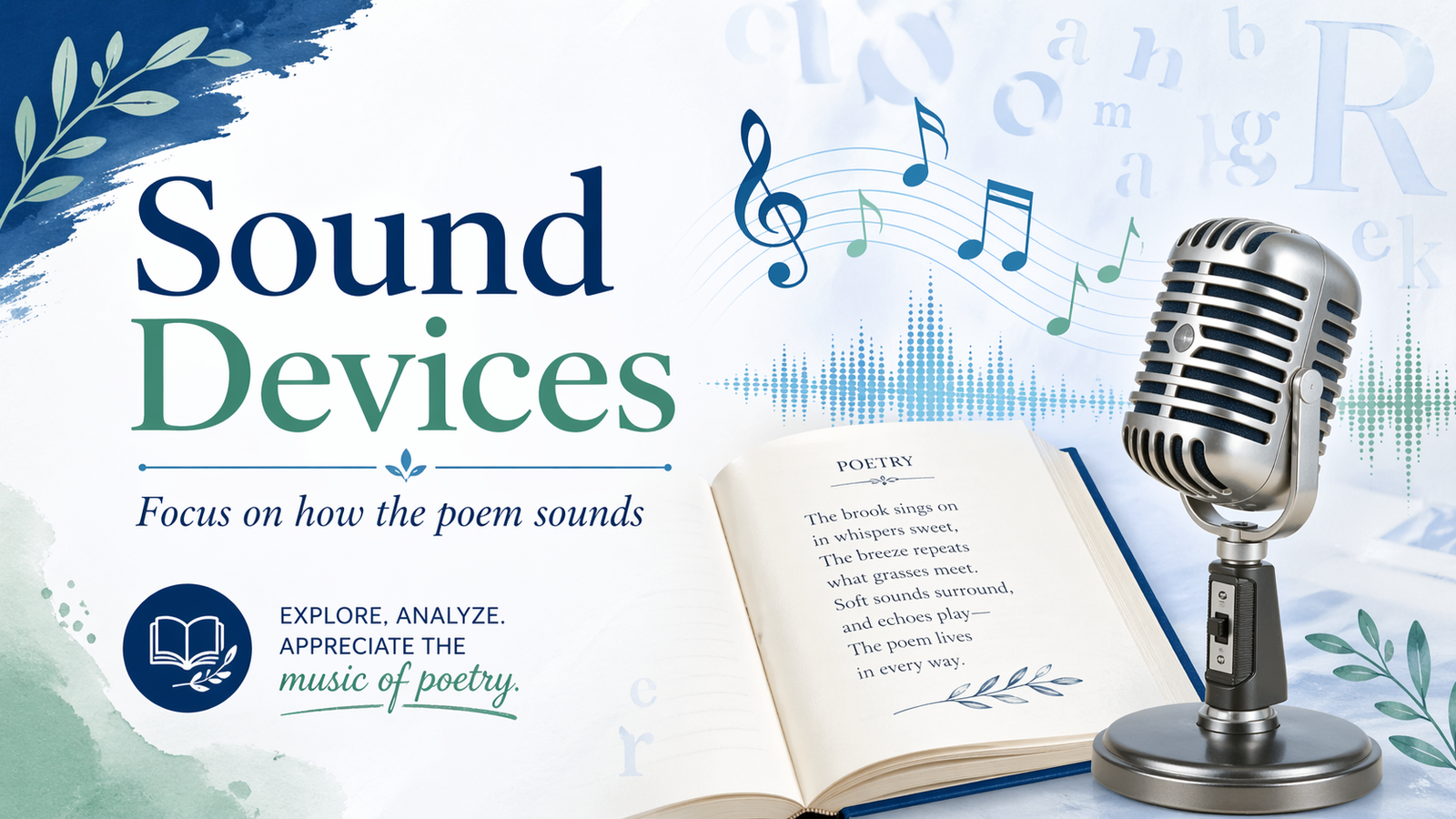
- Sound devices (Focus on how the poem sounds)
- Figurative Language (Creates vivid imagery and comparisons)
- Structural Devices (Focus on how the poem is built)
- Theme-Enhancing Devices (Adds depth to the poem’s meaning)
One thing to note here is that, even though they are called ‘poetic devices’, we use them in our day-to-day lives too. Therefore, the examples given here are sometimes from poems, and sometimes from speech/prose. Let’s dive into each of the categories
Sound Devices (Focus on how the poem sounds)
These tools help to create a pleasant sound when the words are read and adds to the atmosphere. They enhance the musical quality and emotional impact of the poem. They also shape the rhythm, melody, and tone, making the poem more engaging and memorable.
1. Alliteration
Definition: Repetition of the same consonant sound at the beginning of words.
Example: “Peter Piper picked a peck of pickled peppers”.
Example:
A famous example is when Martin Luther King, Jr said,
“I have a dream that my four little children will one day live in a nation where they will not be judged by the color of their skin but by the content of their character.”
These ‘C’ sounds are hard and strong and help the speaker to sound determined and confident.
2. Assonance
Definition: Repetition of vowel sounds within words.
Example: “The early bird heard the word”.
Example:
“And so all the night-tide, I lie down by the side
Of my darling—my darling—my life and my bride.”
(Edgar Allan Poe, “Annabel Lee”)
Notice, how the repetition of “i” sounds in “night-tide,” “lie,” “side,” and “bride” creates a melodic and sorrowful effect.
3. Consonance
Definition: Repetition of consonant sounds in the middle or at the end of words.
Example: “The lumpy, bumpy road”.
Example:
“The ship has sailed to the far-off shores.”
The repetition of “sh” and “s” sounds mimics the flow of water, enhancing the imagery.
How are assonance and consonance different?
| Assonance | Consonance |
|---|---|
| Vowels are weak letter and hence usually generate soft, long sounds. Thus, they creates a soft, fluid, or melodic effect, often evoking a sense of harmony or emotional depth. | On the other hand, Consonants, being solid sounds, can evoke stronger, harsher emotions or intensify descriptions, depending on the consonant sounds (e.g., “k,” “t” for harshness; “m,” “l” for softness). |
| Adds musicality | Adds emphasis |
| “Do not go gentle into that good night” (Dylan Thomas) | “And the silken, sad, uncertain rustling of each purple curtain…” (Edgar Allan Poe) |
4. Rhyme
Definition: Repetition of similar sounds at the ends of lines.
Example: “The cat in the hat sat on the mat”.
We have read about it in the previous week.
5. Onomatopoeia
Definition: Onomatopoeia refers to words that imitate natural sounds, and they are often used in poetry and prose to bring scenes to life.
Examples: “buzz,” “hiss,” “clang”.
Examples:
i.
“The moan of doves in immemorial elms,
And murmuring of innumerable bees.”
(Alfred Lord Tennyson’s “The Princess”)
Notice, how “Murmuring” imitates the low, continuous sound of bees.
ii.
“Hark, hark!
Bow-wow.
The watch-dogs bark!”
(William Shakespeare’s “The Tempest”)
The words “Bow-wow” and “bark” imitate the sound of dogs.